
Sprocket ratio – Measurements
€0.10
Description
Article no.: 16072
Drive gear ratio
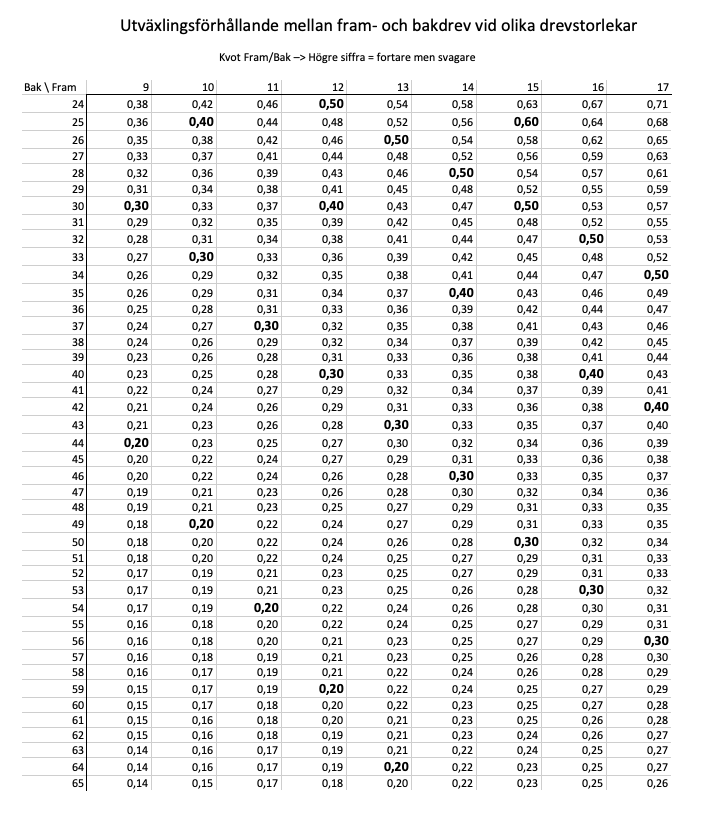
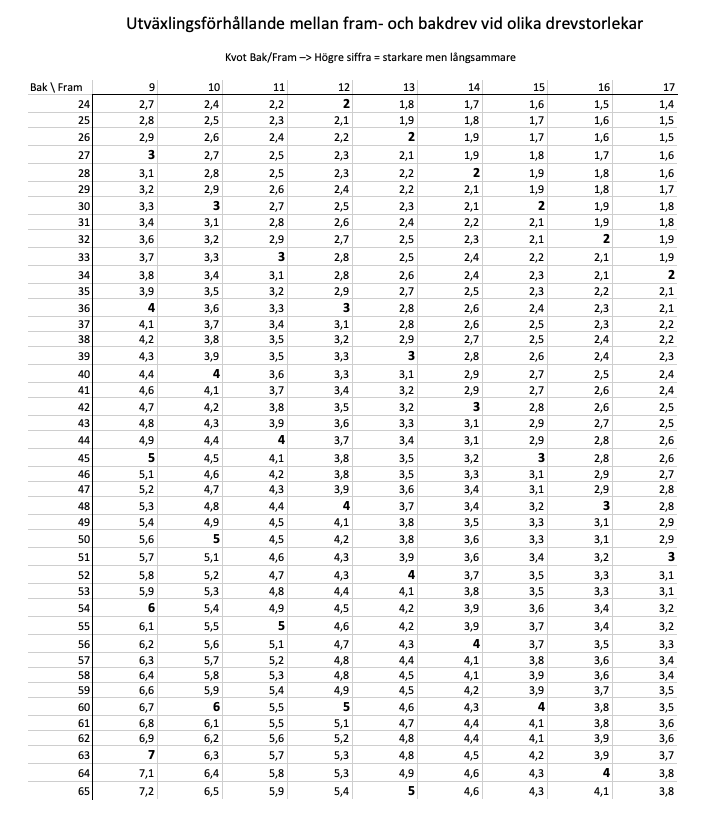
For example, if you have 12 at the front and 30 at the rear, this gives a gear ratio of 2.5. In other words, to turn the rear wheel one revolution, the front sprocket needs to turn 2.5 revolutions.
If you then want the moped to go faster because you have "weight compensated" a little, you can e.g. change the front sprocket to 13 which gives a gear ratio of 2.3. I.e. the front sprocket needs to spin 2.3 turns to drive the rear wheel one turn. This gives a speed increase of (2.5-2.3)/2.3 = (approximately) 9% at the same speed. So, if you were previously doing 30 km/h at 8000 rpm, the moped will now do 30*1.09 = 32.7 km/h at the same rpm.
If you cannot change the front sprocket because you already have the maximum size, you can change to a smaller rear sprocket instead. If we look in the table for 12 front to achieve 2.3 in gear ratio, we find that 27 or 28 rear gives the same speed increase at the same rpm.
You can also, for example, see how to maintain the same gear ratio when switching to other sprockets both front and rear. For example, if you can go up to a maximum of 14 at the front at a ratio of 2.5, you need to go to 35 at the rear for the engine to work exactly the same as at 12/30.
- Secure payment by card, Swish and Paypal
- Invoice, divided payment, direct payment via Klarna
- E-mail or call us, we reply swiftly!
